
Game Trading Systems and Itemization: A comparison between Path Of Exile and Torchlight: Infinite
For those uninitiated, Action Role Playing Games allow a player to control one character and kill monsters. Items drop upon killing monsters. Items dropped can vary in quantity, rarity, and can be useful for the player’s characters to equip, gaining bonuses and increasing their character’s power level.
It is notable that many multiplayer games fit in a central player-led exchange for their players to obtain items. The reasons? Usually the possibilities of player interaction, and whatever emergent behaviour that falls out from that. Yet over time we’ve seen even primarily single player games adopt the feature to foster some sort of a community - beneficial for business purposes.
However, what’s not looked at thoroughly is the effects on gameplay. Here are some generally known, accepted effects on games with trading systems:
- Players can exchange something they don’t need for something they do, adding utility to non-relevant drops. Much of the time this gets exchanged to a common exchange currency (eg. gold), if it exists. Proponents of trading systems argue it serves as a layer of “bad luck protection” from streaks of bad item drops.
- Players can use trading systems to bypass gameplay gates, much to the chagrin of game designers. For example, an item drop from a boss can be bought from the trading system instead of doing the boss.
Lesser known microeconomic effects are about the convergence to common market behaviours. Here are some of these effects:
- The player’s perception on an item drop becomes how much currency they can get out of it. This is in contrast to the usual game-designer prescribed slot machine-like feel whereby drops sometimes feel worthless and then a useful item drops.
- The value of items generally gets pushed to the extreme ends as time goes on through the gameplay season, as knowledge gaps get filled up and items get recognized for value. Lower tier items become cheaper to buy, whereas best in slot items get more expensive over time.
- Changes in item value become driven by published trends from influential players, and farming strategies start emerging to cater to the trend accordingly.
PS. Note that when I write “item value’ I’m referring to how the game’s market prices the item.
Itemization systems wrt Trading
Now an item exchange market is nothing with the items and itemization systems that support it. If done right, the market can become something fun, providing additional gameplay. The following write-up will contrast the itemization and markets of two games, Path of Exile 1 and Torchlight: Infinite. At the time of this writing, Path of Exile is at patch 3.28 and Torchlight Infinite is at SS12. Both are free to play games.
Torchlight: Infinite (TLI)
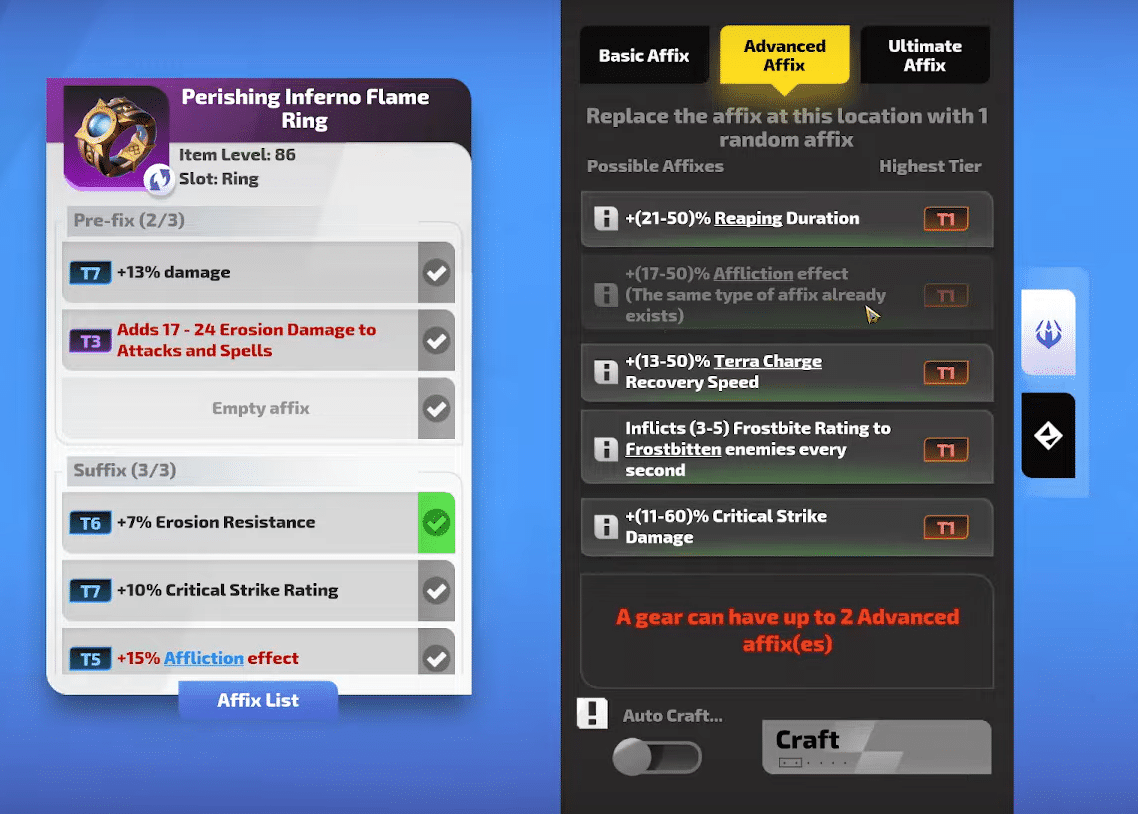
An ARPG styled in the league of legends artstyle, this game has a bit of a mixed relationship trying to find a balance between gacha mechanics and trading systems. It features a short campaign and has a mapping system, and players can increase loot drops by “pulling’ for loot pets.
On interaction with the game’s trading systems, it’s evident that the developers don’t really want you to be abusing the trade system too much and would rather you go grinding through their gameplay systems. For one, a buyer cannot sort by lowest unit price when trying to buy an item. And very often they have to buy in increased bulk which entails higher upfront costs. The developers cite undercutting, economy abusing bots, but these are not problems but features of an exchange market - a lower price is beneficial for all players! It’s fairly flimsy reasoning tbh.
All trade transactions also have a 12.5% tax for the seller, and they can claim a tax refund. The devs claim it fights inflation which I sort of agree with - taking money out of the economy. Still I’d like to see their tax refunds handle concepts like redistribution for the players lagging behind or catching up.
With regards to itemization, TLI has legendary items, and non legendary items have up to six modifier slots to craft. The knowledge depth required to do this is shallow, given that modifiers can be crafted directly to a modifier slot on an item. The odds of getting a specific mod are also shown. There is also automated crafting. It is great quality of life.
However, a shallow knowledge gap has the side effect of evaporating the margins. Which leads us to..
Path of Exile (POE)
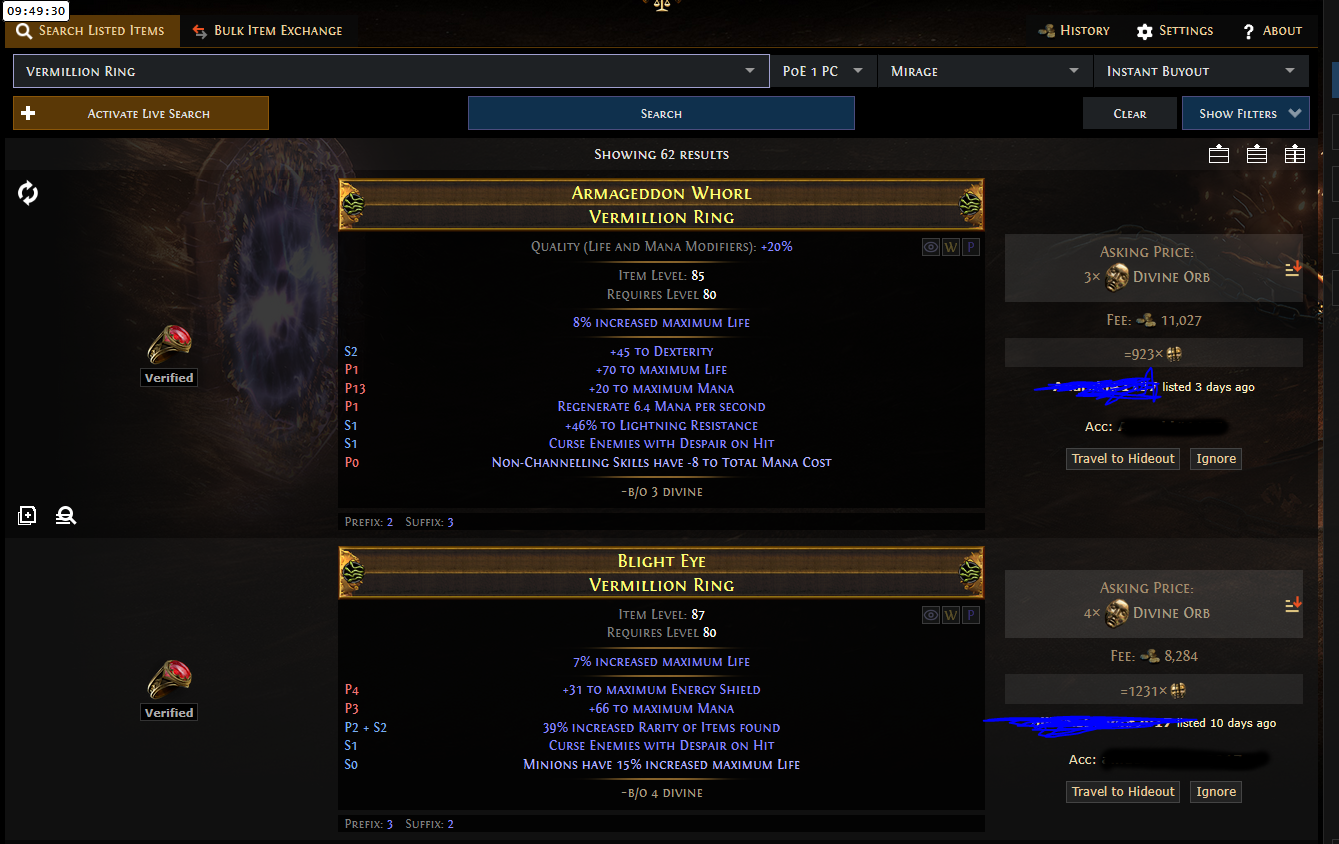
Having had at least a decade of improvements,Path Of Exile has evolved from chat-to-trade all the way to 99% automated trading. Price sorting mechanisms are implemented and items are perpetually up for sale (TLI has limited time for items put up for sale btw). They’ve fully embraced and ironed out most of the friction while still letting you see other player’s decorative microtransactions (a subtle way to get you to buy them).
The thing that really makes it work with markets is their crafting system. Generally, you cannot target-craft a specific modifier on an item. Also, there is always some random variance that affects some other modifier that you might not want changed. Or you might not get the modifier you want when trying to add one through some crafting material. This randomness, combined with perceived knowledge complexity and higher failure rates makes the desirable items a lot more valuable - and sometimes even profitable. There is also no crafting automation.
Due to the knowledge gap and higher failure rates, the market rewards those able to cross these two hurdles. Those who craft a desirable item from it’s low cost bases utilizing knowledge they’ve gleaned can glean a substantial profit margin. Coupled with the trading system, this enables players to “leapfrog’ progression and increase their net worth quickly via profit crafting for those lacking the knowledge to obtain said items.
Game designers might not like this leapfrogging, insisting that everyone has to get through the same gameplay challenge gates. However, consider this: these players are recurring players who come back seasonally, and furthermore, they might not appreciate being on the prescribed rate of progression designers recommend, having done it dozens of times. So why not let them use their knowledge to their advantage? Or even consider a casual player with less time - he/she progresses the gameplay gates as per normal, but there are certain sections that are arduous and disliked - the market thus becomes “bad luck insurance” for that progression/item they are seeking.
Conclusion
Having the feature of exchanging items will always lead to a market. But it need not be a half baked one. Finding an edge, leapfrogging progression is one the things players like doing. For games that have recurring seasons, why not let players have the fun of doing so? Let them play how they like their game to be played. It’s a shared community now.